
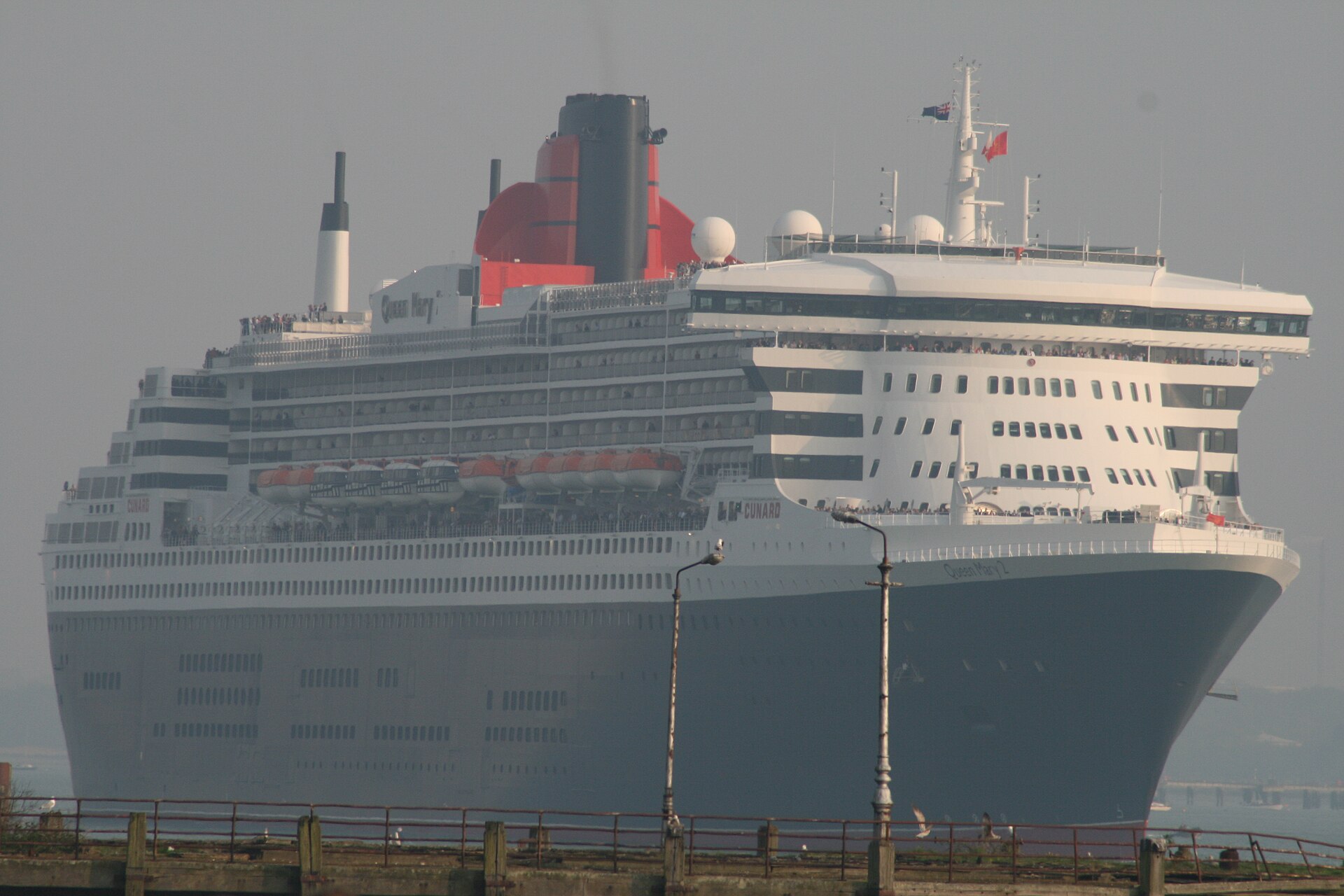
My first visit to a cruise ship began with an awkward conversation with a metal intercom. I left Queen Mary 2 wondering whether medicine at sea might be the unexpected next chapter of my career.
🎧 Listen to this article
Audio article · Read by Chris Woods · Recording to follow
An author-read audio version will be available here. The recording is currently in preparation.
Prefer reading? The full article begins below.
I had travelled to Southampton for a medical recruitment day at Carnival House. Although I knew the area fairly well—it sits beside the site of the annual Southampton International Boat Show—I had never been inside the enormous glass building before.
I parked in the multistorey car park I usually use for the boat show and walked across, not quite knowing what to expect. Perhaps there would be refreshments, some presentations in an office and then a short group visit to one of the ships. I assumed most of the day would take place ashore.

After persuading the intercom to release the revolving door, I approached the reception desk, which stood beyond another set of barriers controlling access to the building. The receptionist recognised that I was there for the medical recruitment event and directed me towards a few small sofa-style seats in the corner of the atrium.
There were only a handful of us. Some had travelled from overseas to attend.
A member of the recruitment team soon arrived, checked our names against her list and issued us with small name badges. She confirmed that we had brought our passports, as instructed, and then led us back outside to a short convoy of taxis.
Apparently, we were going straight to the ship.
Joining Queen Mary 2
Three of us were deposited by our taxi outside what appeared to be an enormous human cattle market.
A cruise had evidently just ended. Hundreds of passengers were pouring out of the terminal with their luggage while we attempted to shuffle awkwardly against the flow. We could not see anyone we recognised from Carnival House, nor any sign explaining where a group of prospective doctors and nurses was supposed to go.
One of the women with me had the telephone number of the recruiter who had met us, but at that particular moment her call went unanswered.
Fortunately, the terminal staff seemed to know what was happening. They directed us back outside and along a raised concrete path beside the building, towards an entirely nondescript door. There, joining crew were surrendering their passports and being issued with ship passes.
Our guide reappeared, and it became apparent that several other attendees had chosen to park at the terminal and meet us there. We joined the queue, handed over our passports and made an educated guess that we required temporary passes for the only ship whose name we could see: Queen Mary 2.
We were given our passes and a firm reminder of the time by which we needed to be back ashore.
From there, we crossed an area normally used for passengers’ luggage and walked up a large ramp into the side of the ship. Photographs were taken, the deadline for disembarking was repeated, and suddenly we were standing in a luxurious corridor aboard an ocean liner, outside the enormous doors of a theatre.
This was unlike any boat I had encountered during my relatively brief sailing career. It was unlike even the largest cross-Channel ferry I had travelled on.
It did not immediately feel as though we were aboard a ship at all.
A hospital at sea
We were taken to a large briefing room with thick carpets and an almost Art Deco interior. Breakfast, tea and coffee were waiting for us. There were considerably more nurses than doctors in the group, including several student nurses who appeared to be approaching the end of their training at Southampton.
We heard short presentations from members of the shoreside medical and recruitment teams. Then we began a tour of Queen Mary 2.
It was not the brief glimpse aboard that I had expected. Over the next few hours, we saw cabins, vast dining rooms, several restaurants, shops, an enormous theatre, passenger decks and crew-only areas.
One of the most memorable spaces was a wide working corridor running much of the length of the ship. It was alive with crew preparing for the next passengers to embark. Away from the polished public areas, this was the operational artery of a very large and complicated machine.
And then, of course, we reached the medical centre.
The ship’s senior doctor—who combined cruise medicine with part-time helicopter emergency medical work while ashore—showed us around. The facilities included two consulting rooms, a small waiting area and several inpatient rooms, configured somewhat differently for passengers and crew.
What struck me most was how well equipped it was.
There was capacity to care for at least two critically ill, ventilated adults. We saw the point-of-care blood-testing equipment and the radiography facilities, which the ship’s doctors learn to operate as part of their training. This was not a hospital, and it could never reproduce everything available ashore, but neither was it simply a GP surgery tucked into the bottom of a ship.
We asked about the case mix, working patterns and what happened when somebody became seriously unwell at sea.
The doctor acknowledged that the overall acuity was lower than in her emergency-medicine career. Much of the work involved routine illness, minor injuries, crew health and primary-care-style consultations. Emergencies, however, still occurred—and sometimes arrived in quick succession.
When that happened, telemedical advice was available, but the team aboard still needed to be capable, organised and effective in the moment. A seriously ill patient might require stabilisation followed by diversion, transfer ashore or evacuation by helicopter. The medical team would be central to both the clinical decision and the considerable practical effort required to make that transfer happen.
We were even told about the ship’s arrangements for emergency blood transfusion. When necessary, suitable volunteers may need to be identified from among those aboard to support a walking blood-bank system. It was an arresting illustration of what resource-limited medicine can mean when the nearest conventional blood bank is over the horizon.
Time to talk to patients
The description that stayed with me, however, was not about ventilation, transfusion or evacuation.
The doctor recalled seeing a passenger overnight and having the time to sit down and explain properly what was happening. She had treated the immediate problem, but had also been able to give the patient the sort of careful, unhurried conversation that often becomes difficult within the time and system pressures of the NHS.
She remembered the satisfaction of practising patient-facing medicine without constantly feeling that another dozen competing demands were pulling her away.
That resonated with me.
I enjoy looking after very sick patients. Emergency medicine and intensive care have trained me to make decisions under pressure, manage uncertainty and work with limited time. But the attraction of medicine is not confined to resuscitation. There is satisfaction in understanding somebody’s problem, explaining it clearly and making the experience of being ill a little less frightening.
Cruise medicine appeared to contain both possibilities: plenty of comparatively low-acuity clinical work, punctuated by occasional situations in which the team’s preparation and judgement would matter enormously.
Life beyond the medical centre

Before the tour ended, we were shown the swimming pools, gyms and passenger facilities. As doctors are senior officers, we were told that many guest areas would be available to us when we were off duty and circumstances allowed.
Questions about uniforms, laundry and housekeeping were easy for the team to answer. Equipment and services were provided, officers’ cabins received housekeeping, and we were shown an unexpectedly elegant officers’ mess.
The doctor joked that one of the occupational hazards was the heavily subsidised alcohol. The corresponding rule, of course, was that medical staff could consume very little: an emergency might require them at any time.
Apart from a modest charge for satellite internet, there appeared to be very little to spend money on while aboard. Accommodation, meals, laundry and most of ordinary daily life were taken care of.
As if to demonstrate the point, the final stop was one of the main passenger dining areas. We were encouraged to choose whatever lunch we wanted alongside the newly arriving guests. There was nowhere to pay because, for us, there was nothing to pay.
The idea stops being hypothetical
By the time we disembarked, we had spent perhaps three hours touring the ship. Each of us had been able to speak informally with the others and ask almost any question we could think of.
I had attended with a vague sense of, Why not? I might as well have a look.
I did not really expect to pursue it.
I left thinking that a predominantly low-acuity, patient-facing role—with occasional critically ill patients, shipboard emergency training, point-of-care diagnostics, radiography and the strange logistical problems created by practising medicine at sea—might be genuinely fascinating.
There would undoubtedly be challenges. But there was something appealing about doing useful clinical work in an unusual environment while much of life’s routine administration was temporarily taken care of.
It felt like an opportunity to use the skills and knowledge I had spent years developing without automatically choosing the hardest available version of work.
Why now?
I am approaching the end of dual specialist training in emergency medicine and intensive care. The obvious next step is an NHS consultant post.
Cruise-ship doctor is, in some respects, a more junior role than the one for which I am about to qualify. The salary is also lower than I could earn as an NHS consultant, and time away would mean foregoing further NHS pension accrual.
But the conventional consultant career is not composed entirely of dramatic resuscitations and intricate critical-care decisions. It also involves governance, administration, education, leadership, complaints, rotas and meetings—alongside increasingly selective periods of direct clinical care.
I expect much of that work eventually to be worthwhile. I am simply no longer convinced that I must move immediately from one obvious career stage into the next without pausing to ask what sort of life I actually want.
Perhaps doing something different for a while would help me discover which parts of medicine I most want to keep.
It would also fit a wider period of change. I am planning an extended sailing voyage aboard my own yacht, Samphire, and I am increasingly drawn towards a life that leaves space for travel, boats and experiences that cannot be fitted neatly around a conventional full-time career.
Cruise medicine may be a temporary adventure between training and an NHS consultant post. It may become one strand of a varied career. Or I may discover that life and medicine at sea suit me better than expected.
None of those outcomes would make the years I have spent training a waste. Sunk costs are still sunk costs, even when they happen to include several postgraduate examinations and a disconcertingly large collection of lanyards.
And how strange would it be to reject an opportunity because I might accidentally enjoy it too much?
The questions I cannot answer yet
- Will repeated low-acuity consultations become boring?
- Will being away from family and friends for twelve to sixteen weeks at a time be too much?
- Will living and working every day within a tightly structured institution feel constraining—or will it be a relief?
- How different will the reality be from the polished version presented during a recruitment day?
- What happens when the weather is poor, the ship is days from the most appropriate hospital and somebody is genuinely critically ill?
- And how will I feel when the ship sails without me being the person responsible for navigating it?
There is only one reliable way to answer those questions.
So I applied.
This blog will follow what happens next: the application and interview, medical certification, preparing for my first contract, the realities of living and working aboard, the medicine that can safely be discussed, and the places encountered along the way.
The visit to Queen Mary 2 did not prove that cruise medicine would be right for me.
It did something more important.
It made me want to find out.
Next in Doctor at Sea
The next article will look more closely at the medical centre aboard Queen Mary 2: its facilities, capabilities and the practical realities of providing emergency care at sea.
Leave a Reply